Can a Half-Ton Truck Tow an Overland Trailer? The Math
Most half-ton trucks can tow a 3,000 to 3,500 lb overland trailer. Learn GVWR, GCWR, payload, tongue weight, hitch class and Texas trailer brake rules.
· Koru Overland
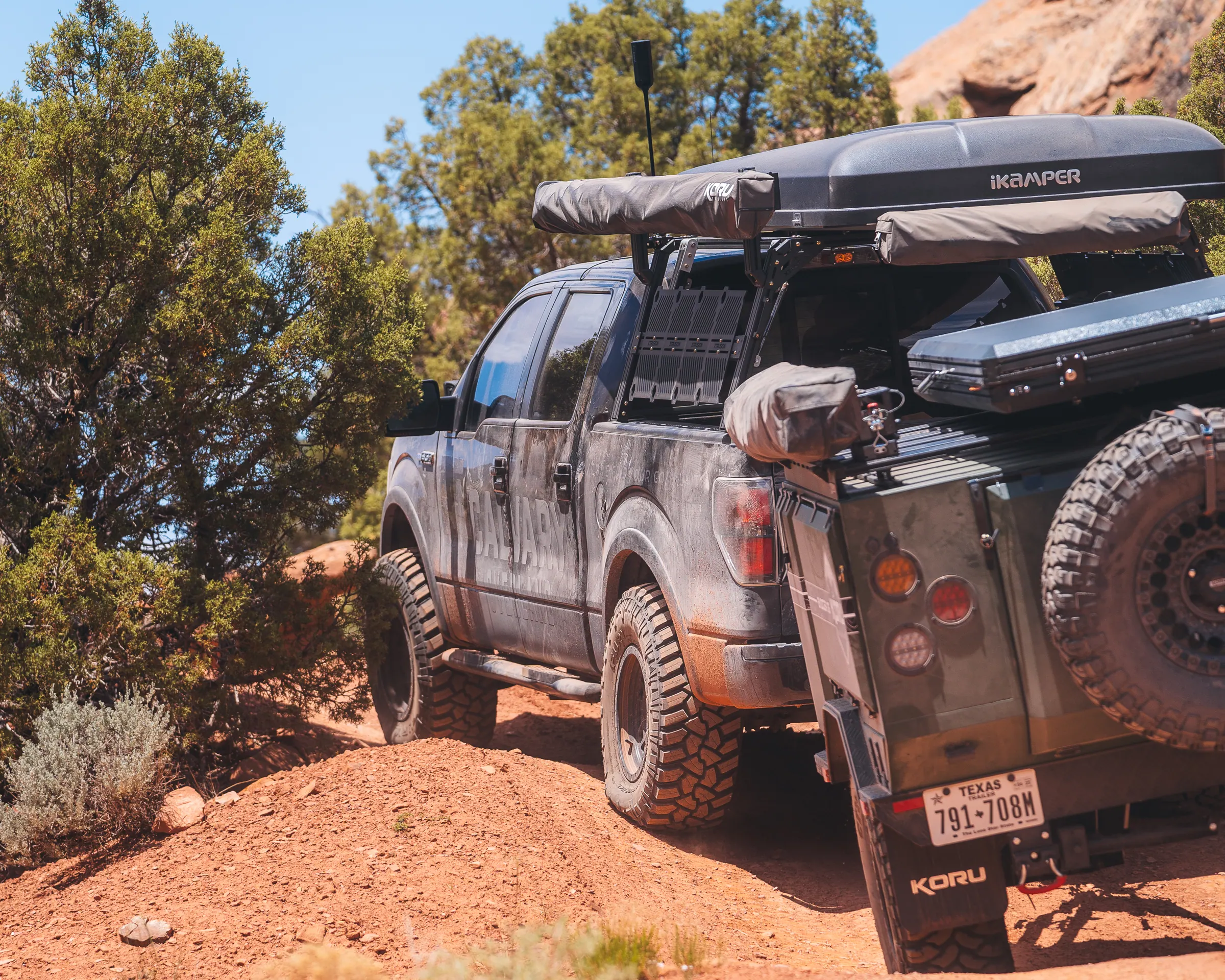
Yes, in most cases a half-ton pickup can tow an overland trailer. Current half-tons such as the F-150, Silverado 1500, Ram 1500 and Tundra have maximum tow ratings between roughly 8,000 and 13,700 lb, while most overland trailers weigh 3,500 lb or less when fully loaded. The limit you are more likely to reach is your truck’s payload, so it pays to do the math before you hitch up.
This guide explains each rating in plain terms, then works through a real example using the Koru Badger 35, the overland trailer we sell from our showroom in Addison, Texas. The same method works for any trailer and any truck.
What do GVWR, GCWR, tow rating and payload mean?
These terms appear on every spec sheet and door-jamb sticker. Definitions below follow the Blue Ox towing guide.
- GVWR (Gross Vehicle Weight Rating): the maximum loaded weight of a single vehicle, including passengers, cargo and fluids. Your truck has one, and so does your trailer.
- GCWR (Gross Combined Weight Rating): the maximum allowed weight of the truck and trailer together, with everything in both.
- Tow rating: the heaviest trailer the truck is rated to pull in a given configuration.
- Payload: the most weight the truck can carry in and on itself, including passengers, cargo, accessories and the trailer’s tongue weight.
- Gross trailer weight (GTW): what the loaded trailer actually weighs on a scale.
- Tongue weight: the downward force the loaded trailer’s tongue puts on the hitch.
The key point: a trailer’s dry weight is what it weighs empty. Its GVWR is the most it can weigh loaded. Always plan around GVWR, because water, propane, food and gear add up fast.
How much can popular half-ton trucks tow?
Here are the maximum available tow ratings that manufacturers publish for current half-ton models. These are best-case numbers for a specific engine, cab, axle and tow package. Your truck may be rated much lower.
| Truck | Maximum available tow rating | Example of a lower configuration | Source |
|---|---|---|---|
| 2026 Ford F-150 | 13,500 lb | PowerBoost hybrid: up to 11,600 lb | Ford |
| 2027 Chevrolet Silverado 1500 | 13,700 lb (5.7L V8) | TurboMax: 9,400 lb | Chevrolet |
| 2027 GMC Sierra 1500 | 13,500 lb (5.7L V8) | 3.0L Duramax diesel: up to 12,100 lb | GMC |
| 2026 Ram 1500 | 11,610 lb | 3.6L Pentastar eTorque: 8,130 lb | Ram |
| 2026 Toyota Tundra | 12,000 lb | Varies by cab, bed and powertrain | Toyota |
Ratings were taken from each manufacturer’s website in October 2026. Model years and figures change, so confirm the rating for your exact truck using the sticker in the door jamb and the owner’s manual.
Why does payload matter more than tow rating?
A half-ton that can pull 11,000 lb may only have 1,500 to 2,000 lb of payload. Everything below counts against that number:
- The driver and passengers
- Gear in the cab and bed (coolers, recovery kit, firewood)
- Accessories (bed rack, rooftop tent, bumpers, winch, larger tires)
- The trailer’s tongue weight
Overland trucks are often heavily accessorized, so payload disappears quickly. Your actual payload is printed on the Tire and Loading Information placard in the driver’s door jamb as “the combined weight of occupants and cargo should never exceed” a given number. That number is for your specific truck as built at the factory, before aftermarket parts.
What is tongue weight, and how much is typical?
For a conventional ball-hitch trailer, tongue weight is typically 10 to 15 percent of the loaded trailer weight. Too little tongue weight can cause sway. Too much overloads the truck’s rear axle and lightens the front wheels, which affects steering and braking.
Tongue weight changes with how you load the trailer. Heavy items placed ahead of the axle raise it; items behind the axle lower it. The only reliable number is a measured one, from a tongue-weight scale or a certified truck scale.
What hitch class do I need?
Hitches are grouped by class. Ratings vary by manufacturer, but typical figures look like this:
| Hitch class | Typical gross trailer weight | Typical tongue weight |
|---|---|---|
| Class I | Up to 2,000 lb | Up to 200 lb |
| Class II | Up to 3,500 lb | Up to 350 lb |
| Class III | Up to 6,000 to 8,000 lb | Up to 600 to 800 lb |
| Class IV | Up to 10,000 lb | Up to 1,000 lb |
Most half-tons come with a 2 inch factory receiver well above what an overland trailer needs. The rule that matters: your system is only as strong as its lowest-rated part. Check the receiver, ball mount, hitch ball and the trailer’s coupler, and use the smallest rating among them.
Do I need trailer brakes in Texas?
Under Texas Transportation Code Section 547.401, a trailer is not required to have brakes if its gross weight is 4,500 lb or less. A trailer heavier than 4,500 lb but not heavier than 15,000 lb is also exempt only if it is towed at 30 mph or less. The Texas DPS summarizes the same rule.
Texas also requires safety chains or a cable connecting the trailer to the tow vehicle under Section 545.410.
A few practical notes:
- Legal minimum is not the same as best practice. Trailer brakes shorten stopping distances and reduce strain on the truck’s brakes on long downgrades.
- Other states differ. If you tow across state lines, check the rules for each state on your route.
- If your trailer has electric brakes, you need a brake controller in the truck. Many half-tons offer an integrated controller, often bundled with a tow package.
- Ask the seller exactly what brake and breakaway setup the specific trailer has.
Worked example: a half-ton and a 3,307 lb overland trailer
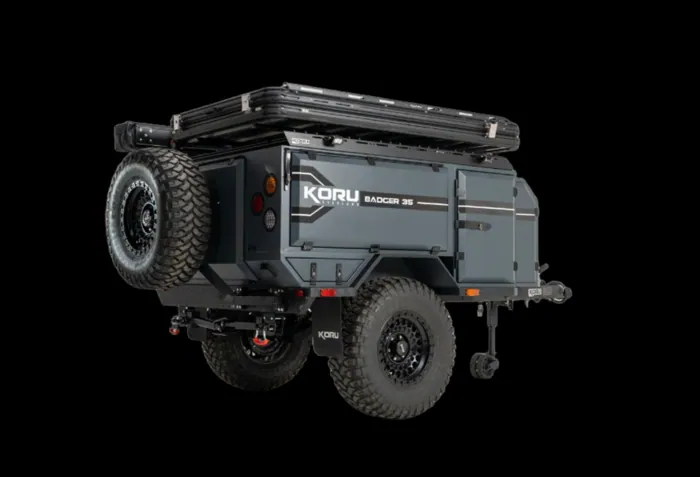
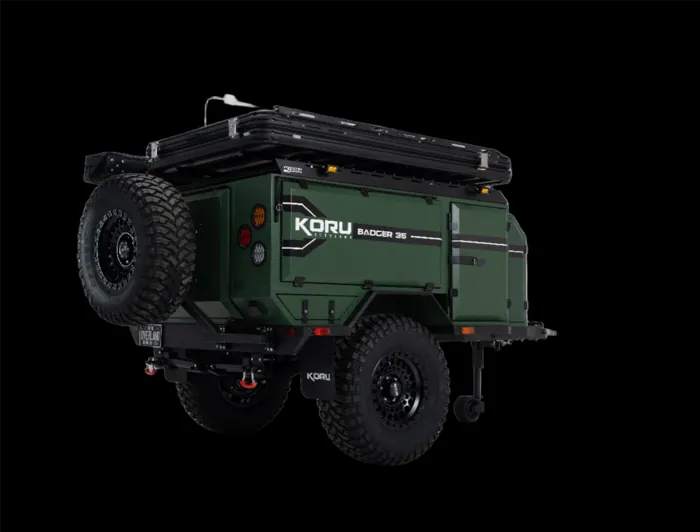
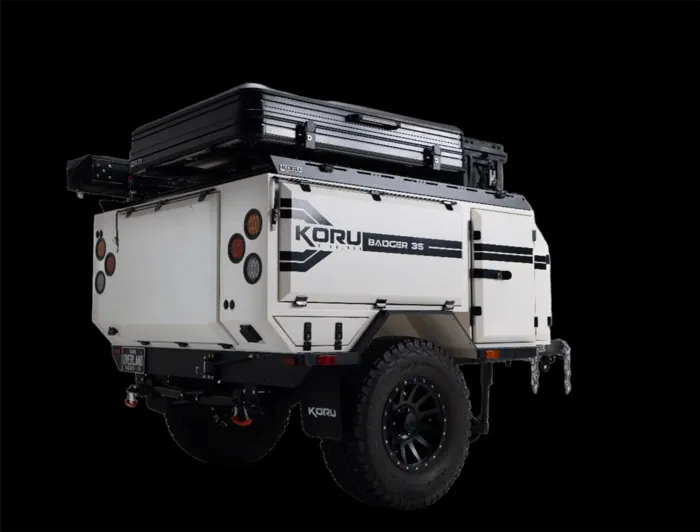
Let’s use the Koru Badger 35. Its published figures are a 2,315 lb dry weight, a 3,307 lb GVWR and 992 lb of payload. We will assume the worst case: the trailer loaded right to its GVWR.
Step 1: Compare GVWR with the tow rating. 3,307 lb is well under any rating in the table above. Even the 8,130 lb Ram configuration leaves about 4,800 lb of margin. The Blue Ox guide suggests keeping loaded trailer weight to no more than 80 to 85 percent of the tow rating; 3,307 lb is about 41 percent of 8,130 lb.
Step 2: Estimate tongue weight.
- 10 percent of 3,307 lb = about 331 lb
- 15 percent of 3,307 lb = about 496 lb
Step 3: Check the hitch. A 2 inch Class III receiver handles both numbers. If you use an older Class II setup rated for 350 lb of tongue weight, the high end of the range would exceed it.
Step 4: Check truck payload. Suppose your door sticker reads 1,600 lb (a hypothetical number for this example):
| Item | Weight |
|---|---|
| Two adults | 360 lb |
| Gear in the bed and cab | 250 lb |
| Bed rack and accessories | 150 lb |
| Tongue weight (high estimate) | 496 lb |
| Total | 1,256 lb |
That leaves about 344 lb of payload. Add a third passenger, a rooftop tent on the truck and a full cooler, and it gets tight. This is why payload, not tow rating, is the number to watch.
Step 5: Check GCWR. Add the loaded truck weight to the loaded trailer weight and compare it with the GCWR in your owner’s manual. With a trailer this size, most half-tons have a comfortable margin, but heavily modified trucks are worth a trip across a scale.
Step 6: Brakes. At 3,307 lb, the trailer is under the 4,500 lb Texas threshold, so Texas law does not require trailer brakes. Brakes are still worth having, and other states may differ.
What about midsize trucks and SUVs?
The same steps apply. Many midsize trucks and body-on-frame SUVs are rated to tow 3,500 lb or more, but their payloads are smaller, so tongue weight takes a bigger share. Run the numbers above with your own sticker figures before you buy.
For more on how weight, power and water fit together, see our overland trailer buying guide. New to the category? Start with what an overland trailer is.
Seeing the Badger 35 in Addison
If you want to check fitment in person, we keep four Badger 35 units in the Addison showroom, one in each color, all listed on our inventory page. Bring your truck and your door-jamb numbers, and contact us to set a time.
Common questions
Can an F-150 tow an overland trailer?
In most configurations, yes. Ford lists a maximum available tow rating of 13,500 lb for the 2026 F-150, but your specific truck's rating and payload depend on engine, axle ratio, cab, bed and options, so check the door-jamb sticker and owner's manual.
How much tongue weight does an overland trailer have?
A common guideline is 10 to 15 percent of the loaded trailer weight. For a trailer loaded to 3,307 lb, that is about 331 to 496 lb, but the only reliable number is one you measure with a tongue scale or a certified truck scale.
Does Texas require brakes on a trailer under 4,500 pounds?
No. Texas Transportation Code Section 547.401 exempts a trailer whose gross weight is 4,500 lb or less from the brake requirement. Rules differ in other states, so check every state you plan to tow through.
What is the difference between GVWR and GCWR?
GVWR is the maximum loaded weight of a single vehicle, such as the truck or the trailer on its own. GCWR is the maximum allowed weight of the truck and trailer together, including all passengers, cargo, water and fuel.
What hitch class do I need for an overland trailer?
Most overland trailers under 3,500 lb fall within Class II or Class III ratings, and most half-tons come with a 2 inch Class III or IV receiver. Always use the lowest rating among the receiver, ball mount, ball and trailer coupler.
Written by the Koru Overland team, a service-disabled veteran-owned company in Addison, Texas. Questions? Call (214) 912-6102 or contact us.