
Off-Grid Power for Overland Trailers: Batteries, Solar, kWh
Lithium vs AGM, amp-hours vs kWh, inverters, DC-DC charging and solar sizing for overland trailers, with worked examples and a daily load-budget table.
· Koru Overland
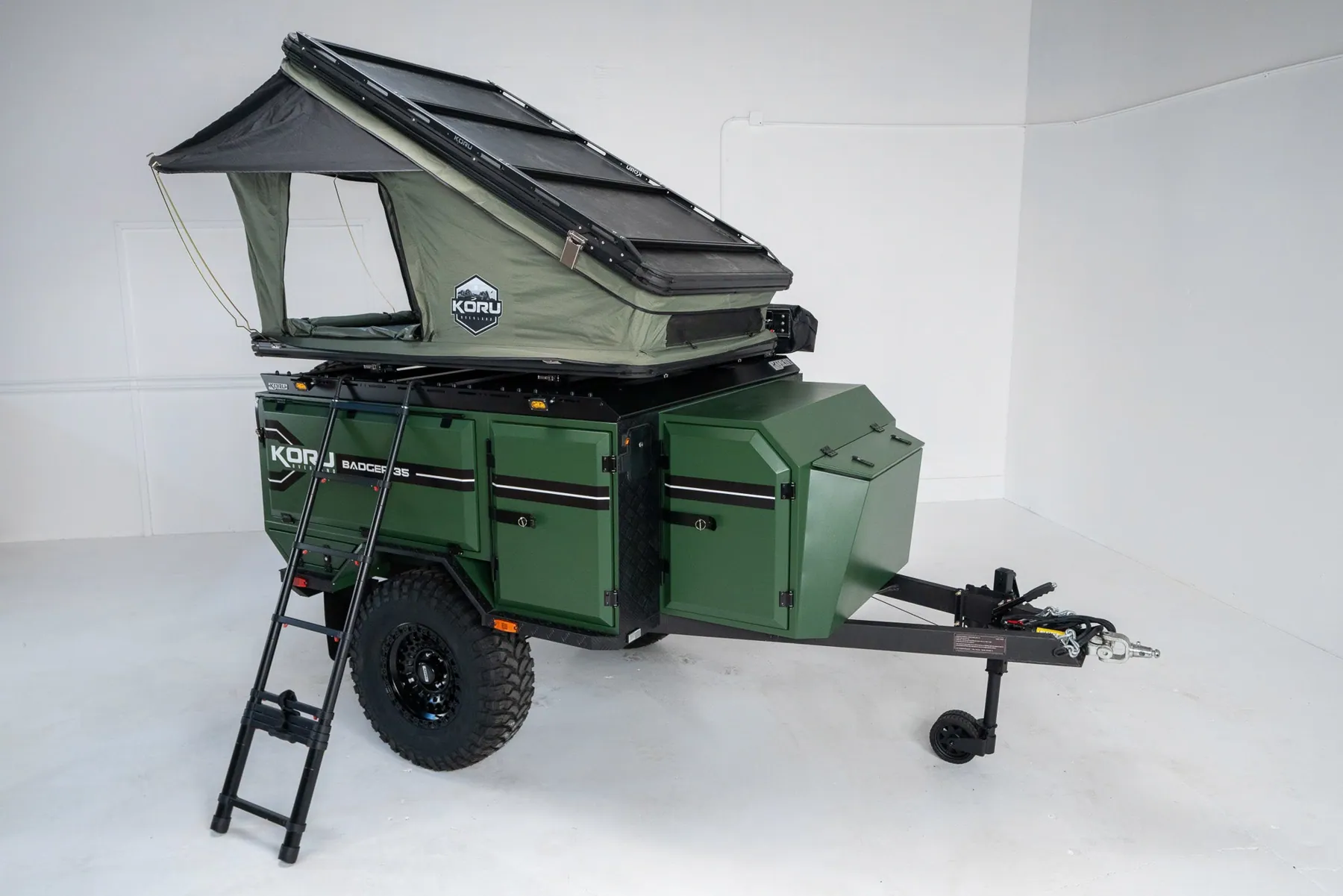
A good off-grid power system is what turns an off-road trailer into a camp you can live from for days. A poorly sized one means a warm fridge on day two. This guide covers the concepts and the math, then works through real numbers using the 150Ah lithium system on the Koru Badger 35, an overland trailer we sell from our showroom in Addison, Texas. The method applies to any trailer.
Lithium vs. AGM
Most overland trailers today use one of two battery types.
AGM (absorbent glass mat) lead-acid batteries are proven and inexpensive up front. Their drawbacks are weight and usable capacity: to protect battery life, many owners avoid discharging AGM much below about half its rated capacity. Voltage also sags as they discharge, which some appliances dislike.
Lithium batteries (most RV and overland units use lithium iron phosphate, or LiFePO4) cost more but weigh less, hold a flatter voltage, and let you use most of their rated capacity. They also tolerate high charge currents well, so they refill faster from a vehicle or solar.
One caution: lithium batteries generally shouldn’t be charged below freezing unless the battery manages that itself. Self-heating batteries warm the cells before accepting a charge, which matters for winter trips.
Amp-Hours vs. kWh
Amp-hours (Ah) measure charge; watt-hours (Wh) measure energy. Energy is what your appliances use, so convert:
Wh = Ah x nominal voltage
A 12V lithium battery has a nominal voltage of about 12.8V, so:
- 150Ah x 12.8V = 1,920 Wh, about 1.9 kWh
- 420Ah x 12.8V = 5,376 Wh, about 5.4 kWh
Those are the Badger 35’s standard REDARC Alpha 150Ah self-heating lithium battery and its 420Ah upgrade option.
Usable capacity
Plan on less than the label. Using 90 percent as a practical usable figure for lithium:
- 150Ah: about 1.7 kWh usable
- 420Ah: about 4.8 kWh usable
For an AGM bank of the same rating, the usable figure would be roughly half.
Inverters: Power vs. Energy
An inverter converts 12V DC to 120V AC for household-style devices. Its wattage rating tells you the largest load it can run at once. It says nothing about how long the battery will last.
The Badger 35 has a 3,000 W inverter. That’s enough for short bursts from things like a coffee maker or a small induction burner, but run the numbers before you rely on it:
- At 3,000 W, the inverter is pulling roughly 250 amps or more from a 12V battery.
- 1.7 kWh usable / 3 kW = about 35 minutes at full output.
- A 1,000 W coffee maker for 6 minutes uses about 100 Wh, which is fine.
Inverters also waste some energy as heat (often 10 percent or so), and many draw power just by being on. Switch the inverter off when you’re not using it, and run 12V devices directly whenever you can.
Charging: Shore, Vehicle and Solar
The Badger uses a REDARC Manager 30 charger, which accepts AC shore power, DC from the tow vehicle and solar input. REDARC rates the Manager30 at up to 30 A of charge current, with a built-in MPPT solar regulator. That 30 A figure is the ceiling for charging current from the unit.
Shore power
Recharging a 150Ah battery from 20 percent to full means putting back about 120Ah. At 30 A, that’s around 4 hours, plus a little time as charging tapers near full.
DC-DC charging from the tow vehicle
A DC-DC charger takes power from your vehicle’s electrical system and charges the trailer battery at the correct profile while you drive. It solves the voltage drop of long trailer wiring runs and works with modern smart alternators.
Example: a 4-hour drive at up to 30 A can return as much as 120Ah, roughly a full recharge of a 150Ah battery from 20 percent. Real results depend on your vehicle’s wiring, alternator output and cable size, so treat this as a best case and confirm your vehicle’s connector is wired for charging.
Solar sizing
A simple way to estimate daily solar harvest:
Daily Wh = panel watts x peak sun hours x 0.75
The 0.75 factor is a conservative allowance for panel angle, heat, wiring and charge-controller losses. Peak sun hours vary by location and season; NREL’s free PVWatts calculator gives estimates for any U.S. location.
Example: 400 W of portable panels x 5 peak sun hours x 0.75 = about 1,500 Wh per day.
Keep the charger’s limit in mind. At lithium charging voltages, 30 A works out to roughly 400 to 430 W into the battery. Extra panel wattage beyond that helps mostly in morning, evening and cloudy conditions, not at midday peak.
Build a Daily Load Budget
Before choosing a battery or solar array, list what you’ll run and for how long. The numbers below are example assumptions, not measurements of any specific appliance. Fridge draw in particular varies a lot with ambient temperature, how often the lid opens and setpoints. Measure your own loads with a battery monitor; the Badger’s REDARC RedVision touchscreen and app show this directly.
| Load | Example average watts | Hours/day | Wh/day |
|---|---|---|---|
| Fridge/freezer (combined, warm weather) | 45 W | 24 | 1,080 |
| LED lighting | 10 W | 5 | 50 |
| Phones and tablet charging | n/a | n/a | 60 |
| Water pump | 60 W | 0.5 | 30 |
| Diesel air heater (cool night, fan and fuel pump) | 25 W | 8 | 200 |
| Laptop via inverter (incl. ~10% loss) | 55 W | 3 | 165 |
| Starlink Mini | 30 W | 6 | 180 |
| Total | ~1,765 Wh |
Worked Examples with the Badger 35
Example 1: Weekend, no charging
With about 1.7 kWh usable from the 150Ah battery and a budget near 1.76 kWh per day, you’d get about one day with every item running. Drop the Starlink and laptop, and skip the heater on a warm night, and daily use falls to roughly 1.2 kWh, which stretches to about a day and a half. For a two-night weekend, plan on some charging.
Example 2: Weekend with solar
Add 400 W of portable solar (about 1,500 Wh/day by the estimate above). Against a 1.76 kWh budget, you’re short only around 250 Wh per day, so the battery declines slowly over several days in good sun. Trim the heater or laptop time and you can break even.
Example 3: The 420Ah upgrade
With about 4.8 kWh usable, the same full 1.76 kWh budget lasts about 2.7 days with no charging at all, and longer with solar or driving between camps. That’s the case for the upgrade if you stay put for long weekends, run comms gear, or camp in cloudy or wooded spots.
Example 4: Low-power comms
A Starlink Mini drawing about 30 W on its own runs roughly 57 hours on the 150Ah battery or roughly 160 hours on 420Ah (assuming 90 percent usable, no solar). For more on running comms off-grid, see our article on Starlink and LoRa for off-grid communications.
Practical Tips
- Measure first, then size. A week of monitor data beats any table.
- Prefer 12V appliances over running 120V devices through the inverter.
- Pre-cool the fridge on shore power before you leave.
- Park for solar, or use portable panels you can place in the sun while the trailer sits in shade.
- Check fuses and connections after rough roads.
Where to Go from Here
Power is one part of choosing a trailer. Our overland trailer buying guide covers weights, water and sleeping setups, and our Texas trip guide has places to put it to work.
If you’d like to see the Badger’s REDARC system in person, the Green Badger 35 and the rest of our in-stock overland trailers are at our showroom in Addison, Texas.