Overland Trailer vs Rooftop Tent vs Teardrop: Which Fits?
Rooftop tent, teardrop or overland trailer? Compare cost, setup time, weather, storage, towing and resale, then use our decision table to pick the right one.
· Koru Overland
A rooftop tent is the cheapest and simplest way to sleep off the ground, a teardrop trailer gives you a hard-sided bed that handles bad weather better, and an overland trailer combines a tent or cabin with a permanent kitchen, water and power you can tow almost anywhere. The right choice depends on your budget, the weather you camp in, and how long you stay out. This guide compares all three side by side and ends with a decision table.
We sell overland trailers from our showroom in Addison, Texas, so we have an obvious interest in the third option. We’ve tried to be fair to all three, because each one is the right answer for some people.
What are the three options?
- Vehicle rooftop tent (RTT): a tent mounted on a roof rack on your truck or SUV. It folds open on top of the vehicle. Hard-shell models open on struts; soft-shell models fold out over a ladder.
- Teardrop trailer: a small towable camper with a hard-sided sleeping cabin and, usually, a kitchen under a rear hatch. Some are built for highways and campgrounds, others for off-road use.
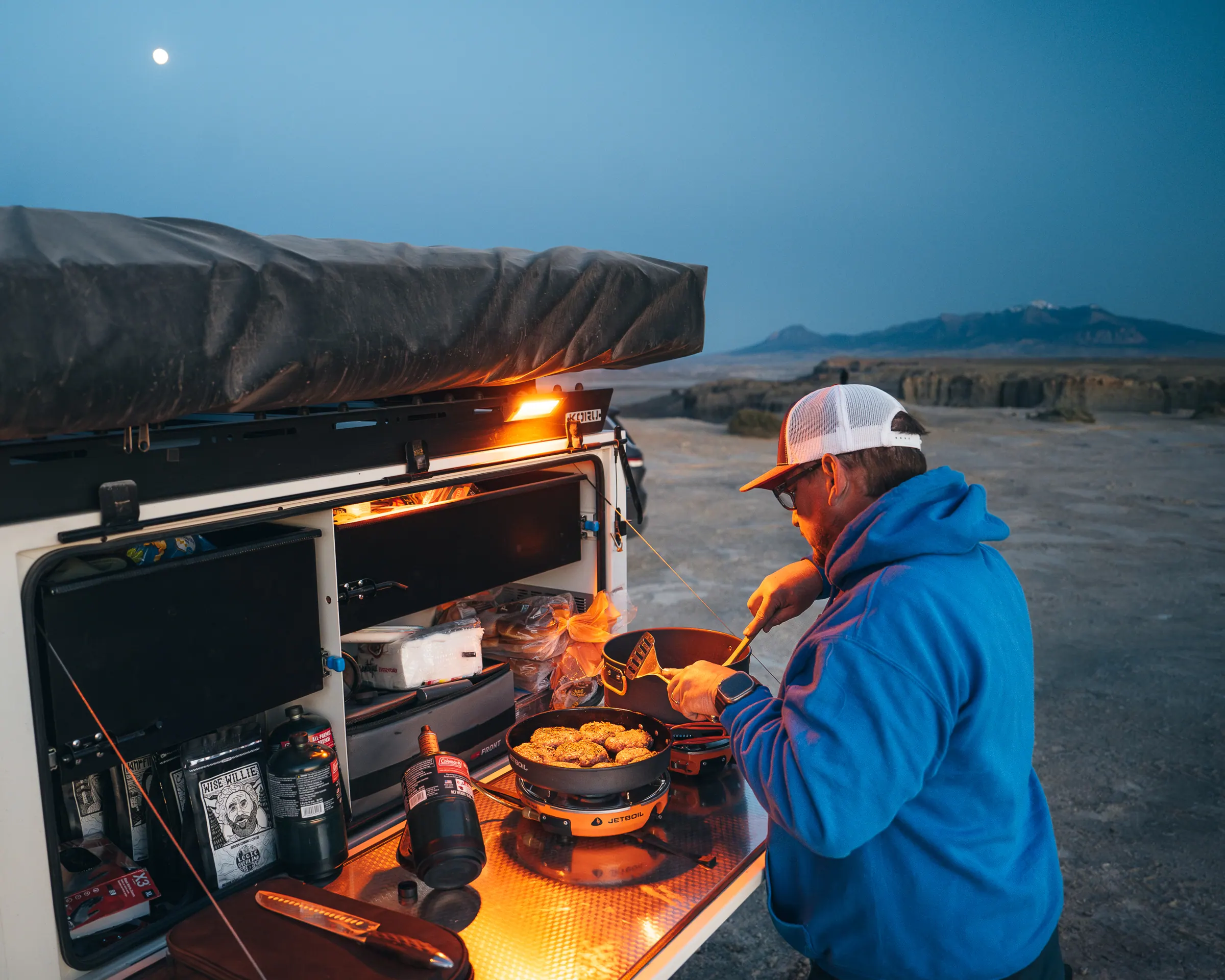
- Overland trailer: an off-road trailer built around self-sufficiency. Many carry a rooftop tent on the trailer’s rack, along with a built-in kitchen, fridge, water tank and battery system. Some use a cabin instead of a tent. For a fuller definition, see what is an overland trailer.
How much does each option cost?
Here are current examples from makers’ websites, checked in October 2026:
| Option | Example | Price | Source |
|---|---|---|---|
| Rooftop tent (hard shell, 2 person) | Thule Basin | $2,999.95 | Thule |
| Rooftop tent (hard shell, 3 to 4 person) | iKamper Skycamp 3.0 | $4,895 list ($3,425 on sale when checked) | iKamper |
| Teardrop/squaredrop (moderate off-road) | Hiker Trailer Mid Range (5x8) | From $8,999 | Hiker Trailer |
| Off-road teardrop | Escapod TOPO2 Nomad | $33,990 | Escapod |
| Off-road teardrop | Off Grid Trailers Pando 3.0 | From $37,999 | Off Grid Trailers |
| Overland trailer (rooftop-tent platform) | Off Grid Trailers Switchback | $22,999 (tent not included) | Off Grid Trailers |
Remember what each price covers. A rooftop tent price usually buys only the tent. You may also need a roof rack rated for it, plus a separate kitchen, cooler or fridge, and power. A trailer price often includes some or all of that. Compare complete setups, not headline prices.
How long does setup take?
- Rooftop tent: Hard-shell tents are built for speed. iKamper advertises a 60 second setup for the Skycamp 3.0, and Thule says the Basin opens in under a minute. Soft-shell tents take longer because you unfold them and set poles or straps. The catch: you must close the tent before you can drive anywhere, even to get firewood.
- Teardrop: Close to zero setup for sleeping. Open the door and the bed is made. Kitchen setup means lifting the rear hatch.
- Overland trailer with a rooftop tent: The tent opens in a similar time to a vehicle RTT. Because it sits on the trailer, you can unhitch, leave camp standing and take the vehicle out to explore.
Which handles bad weather best?
A teardrop wins here. Hard walls, a solid roof and a real door keep out wind, rain and dust better than fabric, and you never climb a ladder in a storm.
A hard-shell rooftop tent is better than a soft-shell in wind and rain, but you still sleep inside fabric walls. Thule describes the Basin as having an insulated roof and a weather-resistant canopy.
An overland trailer depends on its sleeping setup. A rooftop-tent trailer shares the tent’s weather limits, but adds a covered kitchen if it has an awning, and many offer a diesel or propane heater. A cabin-style overland trailer behaves more like a teardrop.
What about storage and gear?
- Rooftop tent: Takes up your roof, so bikes, boats and cargo boxes must go elsewhere. All other gear stays in your vehicle.
- Teardrop: Adds a sleeping cabin and a rear galley. Storage varies widely; smaller models fill up fast.
- Overland trailer: Usually the most storage of the three, with drawers, boxes, a roof rack and a fixed kitchen. Water, fridge and gear move out of your vehicle and stay packed between trips, which can turn trip prep into hitching up and going.
How does each affect towing and driving?
| Factor | Rooftop tent | Teardrop | Overland trailer |
|---|---|---|---|
| Added weight | Tent on the roof (Thule Basin 176 lb; Skycamp 3.0 165 lb) | Trailer, often 1,600 to 2,300 lb dry (off-road models) | Trailer, often 1,300 to 2,400 lb dry |
| Needs a hitch | No | Yes | Yes |
| Counts against vehicle payload | Full tent weight, plus rack | Tongue weight only | Tongue weight only |
| Effect on handling | Higher center of gravity | Towing a trailer; reversing takes practice | Towing a trailer; reversing takes practice |
| Tight trails | Easiest | Depends on width and clearance | Depends on width and clearance |
Two things stand out. A rooftop tent’s full weight sits on your roof and counts against your vehicle’s payload and the roof rack’s rating. A trailer’s weight mostly rides on its own axle, with only the tongue weight on your hitch. For the full math on tow ratings, payload and tongue weight, see can a half-ton truck tow an overland trailer.
What about resale?
We are not aware of reliable published resale data for any of these categories, so be wary of anyone quoting precise percentages. Some general points hold:
- Rooftop tents are small and easy to ship, which widens the pool of buyers.
- Trailers from established brands, with service records and well-kept batteries, tires and canvas, are easier to sell.
- Fit matters. A rooftop tent may not suit your next vehicle, while a trailer can move to a new tow vehicle if the hitch and weights work.
Who is each option best for?
A rooftop tent suits you if you are solo or a couple, take shorter trips, move camp often, and want the lowest cost and simplest setup.
A teardrop suits you if you camp in cold, wet or windy weather, want a real bed without a ladder, and mostly use established roads or moderate trails.
An overland trailer suits you if you take multi-day trips without hookups, want a permanent kitchen, fridge, water and power ready to go, and like leaving camp set up while you explore.
Can you combine them?
Yes, and many people do. A common path is to start with a rooftop tent on the vehicle, then move it (or a new one) onto a trailer later, which frees the vehicle’s roof and payload. Some overland trailers are sold “rooftop-tent ready,” with a rack but no tent, so you can reuse a tent you already own. Before you do, check that the tent’s weight and mounting pattern suit the trailer’s rack, and that the trailer’s payload covers the tent plus water and gear.
Decision table
| If your priority is… | Best fit |
|---|---|
| Lowest cost | Rooftop tent |
| Fastest setup for sleeping | Teardrop |
| Best protection from wind, rain and cold | Teardrop or cabin-style trailer |
| Driving away from camp without packing up | Overland trailer or teardrop |
| Long off-grid trips with water and power | Overland trailer |
| No hitch, no trailer to store | Rooftop tent |
| Keeping weight off the vehicle’s roof | Teardrop or overland trailer |
| Narrowest, tightest trails | Rooftop tent |
| Room for gear and a full camp kitchen | Overland trailer |
If you are leaning toward a trailer, our overland trailer buying guide and best overland trailers under $50,000 cover what to compare next.
The Badger 35 at Koru
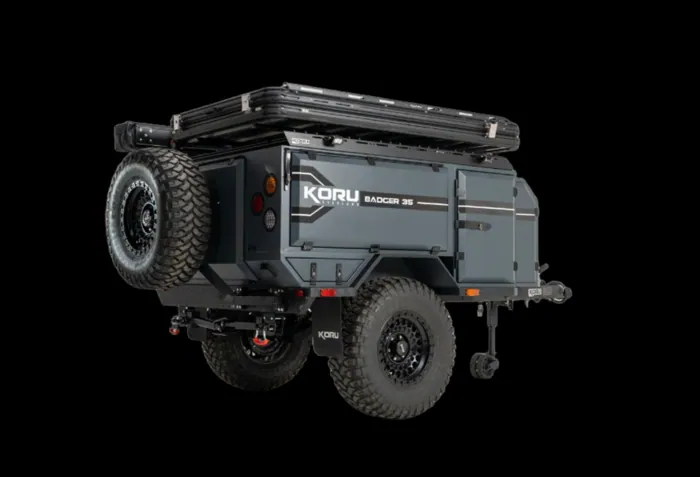
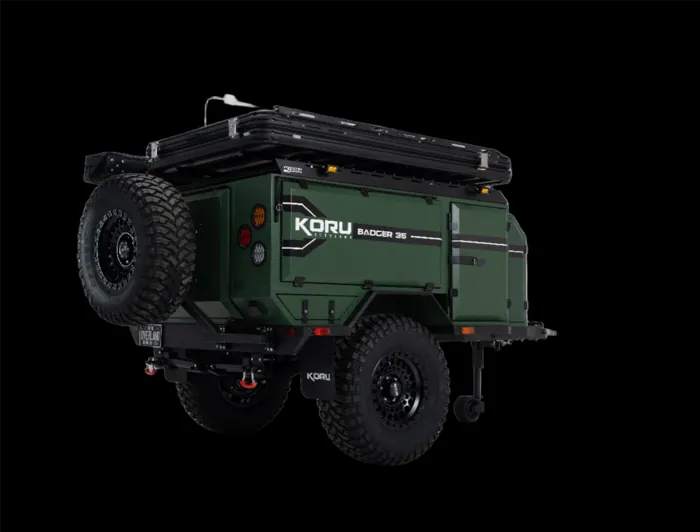
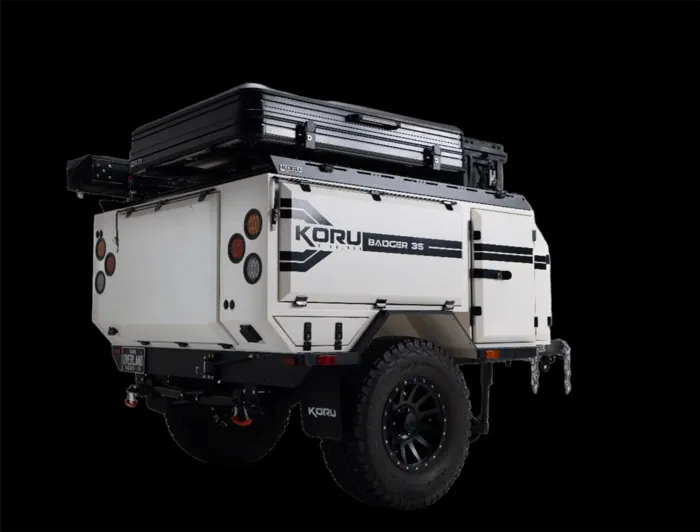
The Koru Badger 35 is an overland trailer of the rooftop-tent type. It carries the tent on its own rack, along with Dometic fridge/freezers, a stove and sink, a 21 gallon water tank, a diesel air heater and a REDARC 150Ah lithium system. It sleeps one to two adults. We have four in stock at our Addison showroom at an in-stock price of $44,900. See them on our inventory page, or contact us to visit.
Common questions
Is a rooftop tent cheaper than an overland trailer?
Yes, by a wide margin. Hard-shell rooftop tents such as the Thule Basin list around $3,000, while equipped overland trailers commonly cost $23,000 to $45,000, although the trailer also includes a kitchen, water and power.
How long does it take to set up a rooftop tent?
Hard-shell rooftop tents are typically designed to open in about a minute; iKamper advertises 60 seconds for its Skycamp 3.0 and Thule says the Basin opens in under a minute. Unpacking the rest of camp, such as the kitchen and chairs, takes longer.
Is a teardrop trailer better than a rooftop tent in bad weather?
Generally yes. A teardrop has hard walls, a solid roof and a real mattress, so it handles wind, rain and cold better than a fabric tent, and you can usually sleep without climbing a ladder.
Can I put a rooftop tent on an overland trailer?
Yes. Many overland trailers are designed around a rooftop tent mounted on the trailer's rack, which keeps weight off your vehicle's roof and lets you unhitch and leave camp in place.
Which option has the best resale value?
We are not aware of reliable published resale data for this category, so treat resale claims cautiously. In general, well-known brands kept in good condition with clear service records tend to be easier to sell.
Written by the Koru Overland team, a service-disabled veteran-owned company in Addison, Texas. Questions? Call (214) 912-6102 or contact us.