Diesel Air Heaters in Camper Trailers: How They Work
How diesel air heaters work in camper trailers: fuel use per hour, 12 V power draw, altitude limits, CO safety, maintenance and diesel vs. propane heat.
· Koru Overland
A diesel air heater warms a camper trailer by burning a small, metered amount of diesel in a sealed combustion chamber, then blowing cabin air across a heat exchanger so the exhaust never mixes with the air you breathe. Common 2 kW units use roughly 0.1 to 0.28 liters of fuel per hour and around 14 to 30 W of 12 V power once running. Installed and maintained correctly, they give dry, steady heat for a full night on very little fuel.
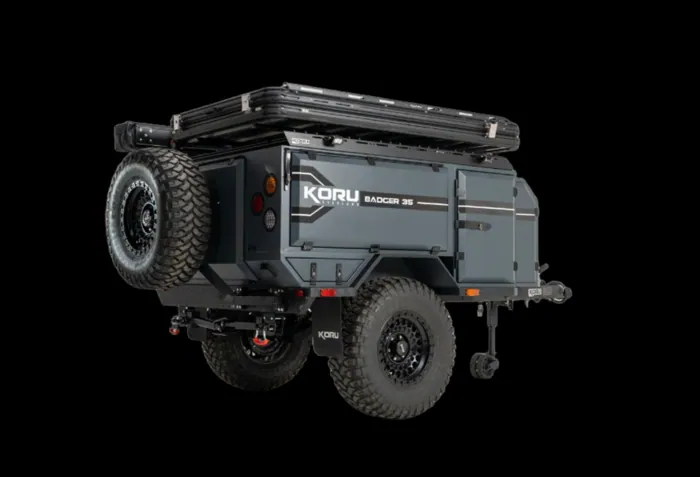
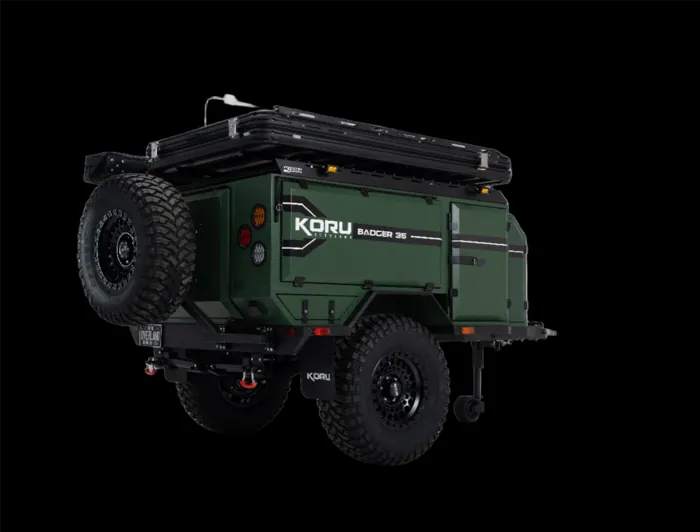
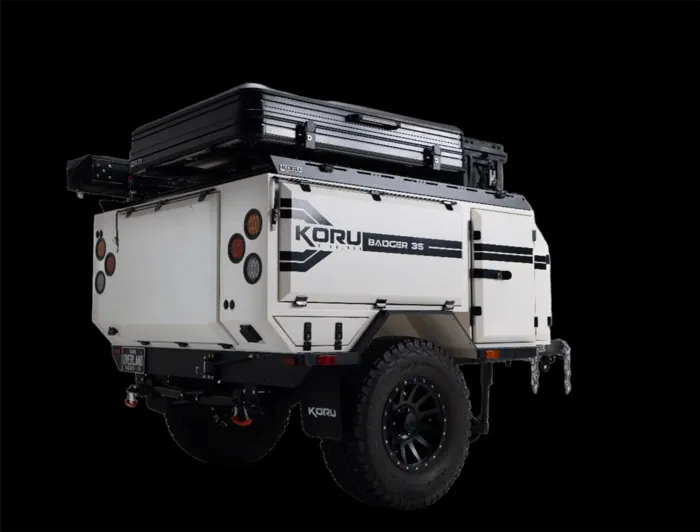
They have become standard on many off-road campers. The Koru Badger 35, for example, carries a digitally controlled diesel air heater. Here is how these heaters work, what they use, and how to run one safely.
How does a diesel air heater work?
A diesel air heater has two separate air paths and a few key parts:
- Fuel pump. A small dosing pump ticks steadily, pushing fuel from a tank to the burner in tiny measured pulses.
- Glow pin. On startup, an electric glow pin heats the burner until the fuel vapor ignites. Once combustion is stable, it switches off.
- Combustion chamber. Fuel burns with outside air drawn in through a combustion air intake. Exhaust leaves through a separate exhaust pipe to the outside.
- Heat exchanger. A metal exchanger surrounds the chamber. A fan pushes cabin air across it and out the outlet duct.
- Controller. A digital controller reads a temperature sensor and adjusts fuel and fan speed to hold the set point.
The important point is the separation. Combustion air comes from outside and exhaust goes outside. The cabin air only touches the hot exchanger. That is why a correctly installed unit adds dry heat without adding combustion moisture or exhaust to the living space.
At shutdown the heater runs a cool-down cycle, with the fan running for a few minutes to clear the chamber. Cutting power during that cycle can shorten the heater’s life, so always shut it down from the controller.
How much fuel does a diesel heater use per hour?
Fuel use depends on the heat setting. Here are manufacturer figures for two common 2 kW class heaters:
| Heater | Heat output | Fuel use | Power use |
|---|---|---|---|
| Webasto Air Top 2000 STC | 0.9 to 2.0 kW (3,100 to 7,000 BTU/h) | 0.12 to 0.24 L/h (0.03 to 0.06 gal/h) | 14 to 29 W |
| Eberspacher Airtronic S2 D2L | Up to 2.2 kW | 0.10 to 0.28 L/h | Low once running |
A worked example
Say the heater averages 0.15 L/h over a cold night, which is a medium setting with cycling. Ten hours of heat uses about 1.5 L, or a little under half a gallon. A 10 L (2.6 gal) fuel tank would cover several such nights. Your actual use depends on outside temperature, wind, insulation, and how warm you like it, so log your own numbers on the first few trips.
How much 12 V power does a diesel heater draw?
Running draw is modest. Webasto lists the Air Top 2000 STC at 14 to 29 W, which is about 1.25 to 2.45 A at 12 V. Over a 10-hour night at an average of 20 W, that is about 200 Wh, a small share of a typical lithium battery bank.
Startup is different. The glow pin draws significantly more for the first few minutes. Two practical points follow:
- Do not start the heater on a nearly flat battery. A low-voltage cutoff can stop it mid-start, which leaves unburned fuel in the chamber and encourages carbon buildup.
- Avoid frequent short cycles. Each start uses extra power and runs the glow pin. A lower, steady setting is usually better than on-off cycling.
For more on battery sizing, see off-grid power for overland trailers.
Do diesel heaters work at high altitude?
Air gets thinner as you climb, so the same fuel pulse has less oxygen to burn with. Without compensation the heater runs rich, which causes smoke, soot and carbon buildup.
How each heater handles this varies:
- Some heaters need a manual altitude adjustment or kit. One Webasto dealer, for example, sells Air Top 2000 STC kits adjusted and bench tested for about 6,400 ft, and a unit set for altitude may need to be reset for low elevations.
- Eberspacher’s newer Airtronic S3 series uses a barometric pressure sensor to adjust automatically up to 5,500 m, depending on the version. Older S2 units adapt to about 3,000 m.
Check your heater’s manual before a trip to the Rockies or other high country. Even in Texas, elevation can matter: Pine Springs Campground in Guadalupe Mountains National Park sits at about 5,730 ft.
Is a diesel heater safe? Carbon monoxide basics
Any burning fuel makes carbon monoxide. The CDC lists headache, dizziness, weakness, upset stomach, vomiting, chest pain and confusion as the most common symptoms, and warns that people who are asleep can die before they notice any symptoms. Treat CO safety as part of the heater, not an extra.
Exhaust routing
- The exhaust must exit outside, away from doors, windows, vents and the heater’s own air intakes.
- Keep combustion air intake and exhaust outlet apart so the heater does not breathe its own exhaust.
- Use the manufacturer’s exhaust pipe, clamps and muffler. Check joints for soot marks, which point to a leak.
- Do not park with the exhaust outlet against a snowbank, a wall or tall grass, and never block it.
- Remember the tow vehicle. A running engine near the trailer is another CO source.
CO alarms
- The CDC recommends battery-operated or battery back-up CO detectors near every sleeping area, with batteries checked regularly and detectors replaced on the maker’s schedule.
- In a camper, choose an alarm made for RV use, commonly listed to UL 2034.
- Test it before each trip. If it alarms, shut the heater down, get everyone into fresh air and do not restart until you find the cause.
Other safety points
- Keep the hot air outlet clear of bedding, clothing and gear.
- Never run an unvented heater of any fuel type in a closed tent or cabin.
- Mount fuel lines away from exhaust and protect them from rocks and debris.
How do you maintain a diesel air heater?
Most problems come from carbon buildup, which comes from short runs, low settings for long periods and poor fuel.
- Run it regularly, including off season. Heater makers commonly recommend running the unit periodically outside the heating season, and a longer run at a high setting helps burn off carbon. Follow your manual’s schedule.
- Use clean fuel. Add an inline filter if one is not fitted. In winter, use fuel suited to the cold, since standard diesel can thicken and clog filters in hard freezes. Ask your fuel supplier about winter blends.
- Inspect the exhaust and intake. Look for soot, cracks, loose clamps and blockages from mud, insects or nests.
- Watch for warning signs. White or black smoke after warm-up, a rough sound, repeated startup failures or error codes all call for service.
- Follow the service interval. Glow pins and burner screens wear. Use a qualified service center for internal work.
Diesel vs propane heat: which is better for a camper trailer?
Both work. The right choice depends on your fuel, your power and how you camp.
| Factor | Diesel air heater | Propane furnace or heater |
|---|---|---|
| Energy per gallon (lower heating value) | 128,488 Btu | 84,250 Btu |
| Fuel source | Separate tank or tow vehicle diesel | Cylinder shared with stove and water heater |
| Moisture in cabin | Dry heat when vented | Dry if vented; unvented heaters add moisture |
| 12 V power | Glow pin surge at startup, then low | Varies; ducted furnaces run a blower fan |
| Noise | Fan and pump tick | Varies by model |
| Altitude | Needs compensation or a kit | Also affected; check the appliance |
Diesel’s higher energy content per gallon means fuel goes further, and it is easy to find on the road. Propane is widely available and simple to store, but if the stove and water heater share the same cylinders, cold-weather heating draws down cooking fuel. Many overland trailers split the jobs: diesel for heat and propane for cooking and hot water.
Cold-Weather Camping in the Badger 35
The Badger 35 pairs its digitally controlled diesel air heater with a REDARC 150Ah self-heating lithium battery, a 3,000 W inverter, and up to 40 lb of propane for the stove and on-demand water heater. If you are planning a winter trip, our overland trailer buying guide covers how heat fits with power and water. See the four in-stock units in the Badger 35 collection.
Common questions
How much fuel does a diesel heater use per hour?
Manufacturer specs for common 2 kW heaters list about 0.12 to 0.24 liters per hour for the Webasto Air Top 2000 STC and 0.10 to 0.28 liters per hour for the Eberspacher Airtronic S2 D2L, depending on heat setting.
How much battery power does a diesel heater use?
Webasto lists 14 to 29 W for the Air Top 2000 STC once running. Startup draws more for a few minutes while the glow pin heats the chamber.
Do diesel heaters work at high altitude?
They can, but thinner air changes combustion. Some heaters adjust automatically with a pressure sensor, while others need a high-altitude kit or setting. Check your model's rating before a high-elevation trip.
Is a diesel heater safe to run overnight?
A properly installed heater vents its exhaust outside and draws combustion air from outside. Pair it with a working CO alarm near the sleeping area and inspect the exhaust line regularly.
Diesel or propane heat for a camper trailer?
Diesel holds more energy per gallon and can share fuel with a diesel tow vehicle, while propane can share cylinders already carried for cooking and hot water. Many trailers use diesel for heat and propane for cooking and hot water.
Written by the Koru Overland team, a service-disabled veteran-owned company in Addison, Texas. Questions? Call (214) 912-6102 or contact us.