Overland Trailer Buying Guide: Weights, Power, Water and More
Shopping for an overland trailer? Learn how GVWR, payload, tongue weight, tires, power in kWh and water capacity affect your choice, plus a buyer's checklist.
· Koru Overland
An overland trailer lets you carry a self-contained camp down roads that would shake a standard travel trailer apart. But the category is broad, spec sheets are dense, and the numbers that matter most (weights, power and water) are easy to misread. This guide walks through what to look for, in the order we’d check it ourselves. We’re Koru Overland, a showroom in Addison, Texas, and we’ve written this to be useful whether or not you ever buy from us.
What Makes a Trailer “Overland” or “Off-Road”?
There’s no legal definition, but a true off-road camper trailer usually shares a few traits:
- Ground clearance and departure angle that let it follow your tow vehicle over ruts, washes and ledges without dragging.
- Light-truck or all-terrain tires on a wheel size that can match your vehicle, so you can carry one spare for both.
- A suspension built for articulation and repeated impacts, not just highway miles.
- Self-sufficiency: onboard battery power, fresh water, cooking and refrigeration, so you can camp for days without hookups.
- A compact footprint that fits narrow two-tracks and tight turnarounds.
A trailer can look rugged and still fall short on any of these. Read past the photos.
Weight Ratings: The Numbers That Matter Most
GVWR vs. tow rating
GVWR (Gross Vehicle Weight Rating) is the maximum the trailer is rated to weigh when fully loaded: the trailer itself plus water, propane, gear, food and anything bolted on. Your vehicle’s tow rating is the most it’s rated to pull.
The safe way to compare is to use the trailer’s GVWR, not its dry weight. A trailer listed at a light dry weight can approach its GVWR quickly once tanks are full and the gear is loaded. If the GVWR is close to your vehicle’s tow rating, you’ll have little margin for heat, grades and dirt roads.
Payload
Trailer payload is the difference between GVWR and dry weight. It’s your budget for everything you add. Water is the item people underestimate: it weighs a little over 8 pounds per gallon, so a 21-gallon tank alone adds roughly 175 lb.
Don’t forget your vehicle’s payload, too. The tongue weight of the trailer, plus passengers, a roof rack, a fridge in the bed and recovery gear, all count against the truck’s or SUV’s payload rating (usually printed on a sticker in the driver’s door jamb).
Tongue weight
Tongue weight is the downward force the trailer puts on your hitch. A commonly cited guideline for conventional trailers is roughly 10 to 15 percent of loaded trailer weight. Too little can cause sway, too much can overload the rear axle and lighten the steering. The best practice is to weigh it: a tongue-weight scale or a trip across a certified truck scale tells you what you actually have, loaded the way you travel.
Clearance, Tires and Suspension
Tires
Matching your tow vehicle’s tire and wheel size is a real advantage off-road. One spare covers both, and the trailer tracks in the same ruts. Look at load rating as well as size, and check the tire’s date code on any unit that has been sitting.
Suspension (speaking generally)
Off-road trailer suspensions vary widely: leaf springs, coil springs, torsion axles, airbags and independent designs all exist, with different trade-offs in articulation, ride quality, maintenance and cost. Rather than chasing a single “best” design, ask:
- How much travel does it have, and what are the shocks?
- How easy is it to inspect and service in the field?
- Are replacement parts available in the U.S.?
Clearance
Ask for the lowest point under the trailer (often the axle, tank or a skid plate) and the departure angle. A trailer that hangs low behind the wheels can drag on dips even if the body looks high.
Power Systems: Think in kWh
Battery banks are often listed in amp-hours (Ah), but amp-hours alone don’t tell you much unless you know the voltage. Multiply them to get watt-hours: a 150Ah, 12V lithium battery stores about 1.9 kWh. That number is what you compare against your daily loads.
Key questions:
- Battery chemistry. Lithium generally offers more usable capacity per pound than AGM.
- Charging inputs. Can it charge from shore power, from your vehicle while driving (DC-DC) and from solar?
- Inverter size. Determines which 120V devices you can run.
- Monitoring. A screen or app that shows state of charge saves guesswork.
We go deep on this in our off-grid power guide for overland trailers, including worked examples and a load-budget table.
Water
Look at fresh tank capacity, how the tank is protected underneath, and how water is heated. Filtration is worth understanding too: most onboard filters improve taste, odor and clarity, but unless a filter is certified for it, treat or disinfect water per local health guidance. In hot, dry country, carry more drinking water than you think you need.
Sleeping and Living Space
Overland trailers usually take one of two approaches:
- Rooftop tent designs keep weight and size down and get you off the ground, but you’re in a tent, with the weather that implies.
- Enclosed cabin designs offer hard walls, more storage and more comfort in heat, cold and wind, at the cost of size, weight and price.
Neither is right for everyone. Think about who’s coming, what seasons you camp in and how often you’ll set up and break down camp each trip.
Storage and Kitchen
Count the actual storage you’ll use: drawers, boxes, roof rack space and where heavy items ride (low and near the axle is generally better). Check the kitchen layout from a cook’s point of view. Is the stove sheltered from wind? Is the fridge big enough for your trip length? Is there a way to cook in the shade?
New, In-Stock or Build-to-Order?
- Build-to-order gives you the most choice, but lead times vary and you buy before you can inspect the finished unit.
- In-stock units can be seen, measured and hitched before you commit, and you can be camping much sooner. The trade-off is that you choose from what’s available, and in-stock inventory may include earlier model years.
- Used trailers can save money but deserve a careful inspection of the frame, suspension, tires, batteries and water system.
Whichever route you take, get the spec sheet in writing, and confirm the exact equipment on the specific unit you’re buying.
Overland Trailer Buyer’s Checklist
- Trailer GVWR is comfortably within your vehicle’s tow rating.
- Estimated tongue weight fits within your hitch rating and your vehicle’s payload.
- Trailer payload covers water, propane and your real gear list.
- Tire size and load rating suit your terrain (ideally matching your vehicle).
- Suspension is serviceable, and parts are obtainable.
- Battery capacity in kWh covers at least one full day of your loads.
- Charging works from shore, vehicle and solar.
- Fresh water capacity fits your trip length and climate.
- Sleeping setup matches your group size and seasons.
- Storage is where you need it, with heavy items carried low.
- Overall height and length fit your garage, storage space or HOA rules.
- You’ve seen the specific unit, or have its specs in writing.
If you’re planning where to take it first, see our list of overland trips from Dallas.
Koru’s In-Stock Overland Trailers in Addison, TX
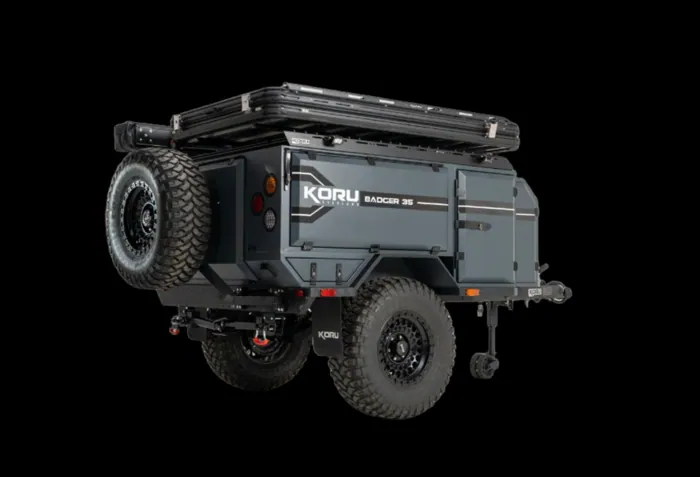
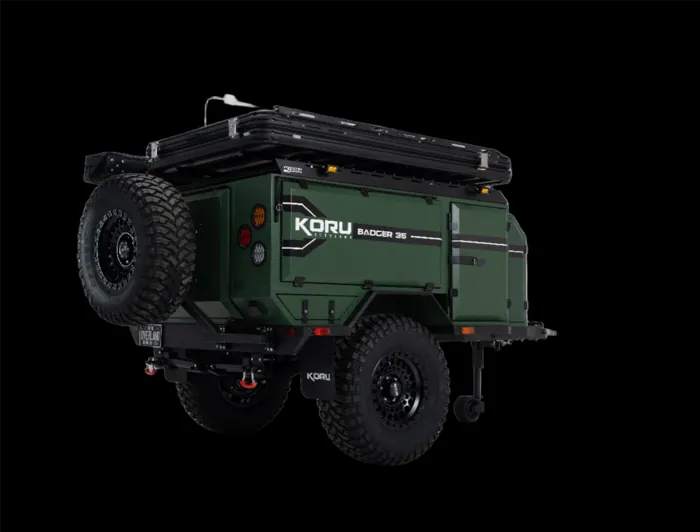
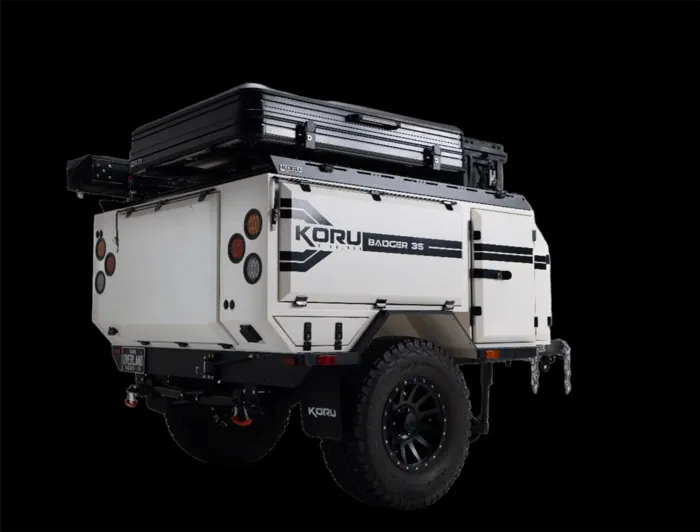
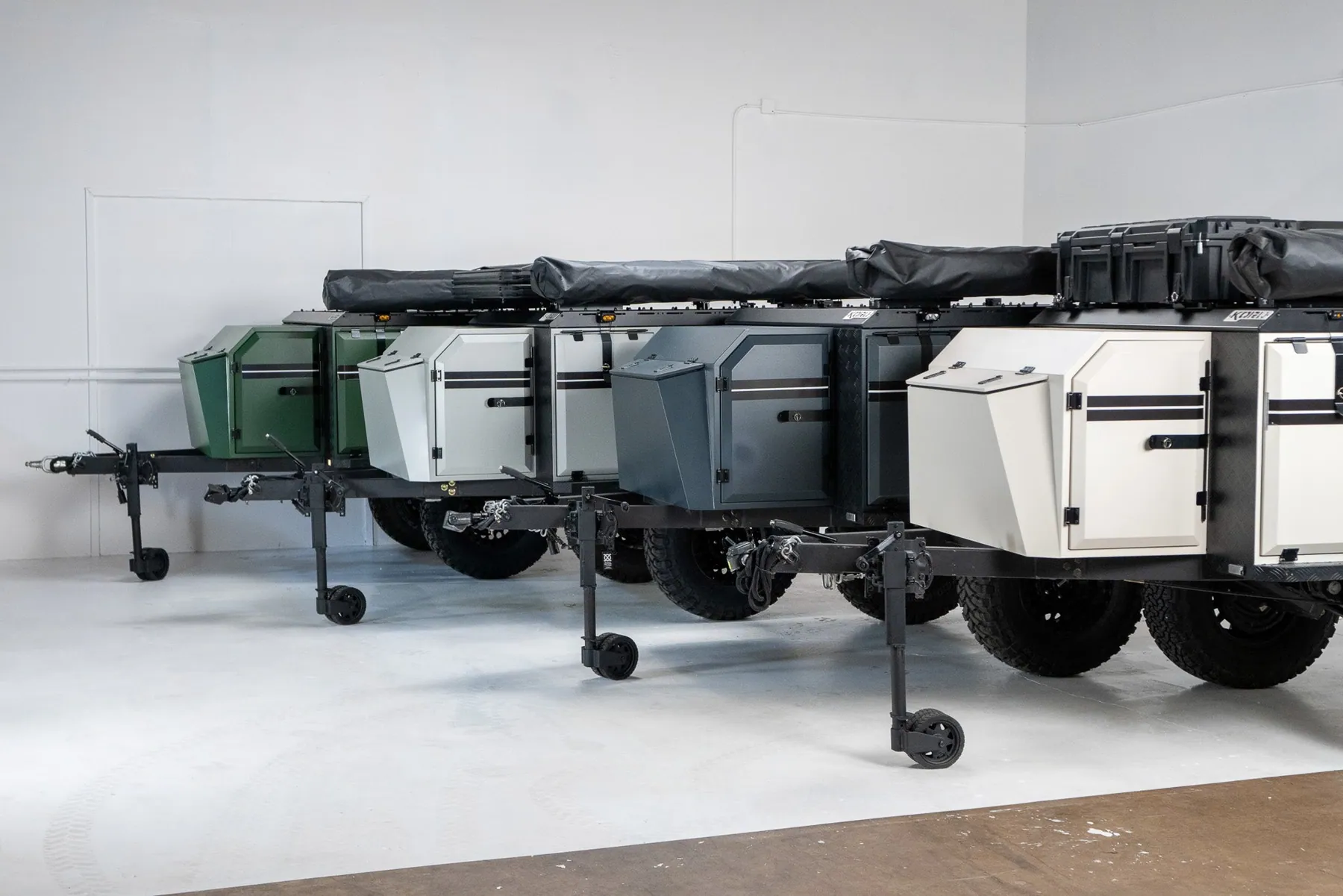
If you’re shopping for an overland trailer for sale in Texas, our current inventory is in the showroom at 4201 Kellway Circle, Suite B, in Addison. At the time of writing we have four 2023 Badger 35 units (Dark Gray, Green, White and Light Gray) at $40,375, down from a $47,500 list price.
The Badger 35 is a compact rooftop-tent design with a 3,307 lb GVWR, 992 lb payload and a 150Ah lithium system. Every unit is fully equipped as listed, so there are no options to add. To see one in person, contact us or call (214) 912-6102.