Overland Trailer Inspection Checklist: Check Before You Buy
A buyer's inspection checklist for off-road and overland trailers: frame, axle, tire date codes, brakes, lights, battery health, propane, seals and paperwork.
· Koru Overland
Before you buy an overland trailer, new or used, inspect it in a fixed order: structure, running gear, safety equipment, onboard systems, then paperwork. A careful inspection takes about two hours, catches most expensive problems, and gives you specific questions to ask the seller. Bring a flashlight, a tire gauge, a spray bottle of soapy water and a phone charger you can plug into the trailer.
This guide applies to any off-road camper trailer. We sell trailers at Koru Overland in Addison, Texas, and this is the same order we would use to look at anyone else’s. If you are still choosing a model, start with our overland trailer buying guide, then come back here for the walk-around.
What should you inspect first on an overland trailer?
Start underneath. Off-road trailers take repeated impacts, and the frame tells you how the trailer has been used and stored.
Frame and welds
- Look along the main rails and crossmembers for bends, kinks or sections that are not straight.
- Check every visible weld, especially at the tongue, spring or suspension hangers and where crossmembers meet rails. Hairline cracks often show up as rust lines in the paint or powder coat.
- Note surface rust versus scaling or flaking rust. Surface rust is cosmetic. Scaling at welds or mounts deserves a closer look.
- Inspect recovery points and the spare tire mount for cracks or elongated holes.
- Look for fresh paint or undercoating in one isolated spot, which can hide a repair. Ask about it.
Axle and suspension
- With the trailer on level ground, compare the ride height side to side.
- Check that bushings are intact, bolts are tight and shock absorbers are not leaking.
- Look at tire wear. Uneven wear on one edge can point to a bent axle, an alignment issue or a damaged suspension arm.
- On independent suspension, check every pivot point for play by prying gently with a bar.
How do you check trailer tires and bearings?
Tires and DOT date codes
Every tire sold in the U.S. carries a DOT code on the sidewall. The last four digits show the week and year of manufacture, so a code ending in 3122 means the 31st week of 2022.
Tires age even when they sit. Many tire and vehicle makers publish age-based replacement guidance, and trailer tires often fail from age before they wear out. Check the specific tire maker’s recommendation, and price replacements into your offer if the tires are older than that guidance.
While you are there:
- Check that all tires, including the spare, are the same size, load range and date range.
- Look for sidewall cuts, bulges, cracking in the tread grooves and plugs.
- Set pressures to the values on the certification label or tire placard.
Wheel bearings
Jack each wheel off the ground and rock it top to bottom. Any clunk or play needs attention. Spin it and listen for grinding. Dexter, one of the largest trailer axle makers, recommends lubricating bearings every 12 months or 12,000 miles. Ask for records. After a short test tow, carefully touch each hub. One that is much hotter than the others is a warning sign.
What should you check on brakes, lights, coupler and chains?
Brakes
Many overland trailers carry electric brakes. Connect to a tow vehicle with a brake controller and test at low speed in a parking lot. The trailer should slow the rig smoothly without pulling to one side. Check the breakaway switch and battery: pulling the pin should apply the brakes.
State brake rules vary. In Texas, Transportation Code 547.401 generally does not require brakes on trailers with a gross weight of 4,500 lb or less, but brakes on a loaded off-road trailer are worth having regardless. Confirm the rules where you live.
Lights (FMVSS 108 basics)
Federal Motor Vehicle Safety Standard 108 sets required lamps and reflectors. For trailers under 80 inches wide, lighting guides based on FMVSS 108 list at least:
| Item | Color | Minimum |
|---|---|---|
| Tail lamps | Red | 2 |
| Stop lamps | Red | 2 |
| Rear turn signals | Red or amber | 2 |
| Rear reflex reflectors | Red | 2 |
| Side marker lamps | Amber front, red rear | 1 each side, front and rear |
| Side reflex reflectors | Amber front, red rear | 1 each side, front and rear |
| License plate lamp | White | 1 |
Trailers 80 inches or wider also need clearance and identification lamps. Test every function with a helper, and check plug pins and wiring at the tongue for corrosion.
Coupler and safety chains
- Check the coupler or off-road hitch for wear, cracks and a working latch.
- Make sure the coupler matches your tow vehicle’s hitch.
- Inspect chains or cables for stretched links, worn hooks and secure attachment to the frame. Texas law, for example, requires safety chains when a passenger car or light truck tows a trailer.
How do you test the electrical system on a camper trailer?
The power system is often the most expensive part of a modern overland trailer. Test it under load, not just with the lights on.
- Battery state of charge and health. Open the battery monitor or BMS app and read state of charge, voltage and any stored faults or alarms. Some systems also show cycle count or a health estimate. Ask how old the battery is and whether it has ever been fully discharged or stored flat.
- BMS behavior. Ask the seller to show what happens at low charge or low temperature. Self-heating lithium batteries should report their heating status.
- Inverter test. With the inverter on, run a known load, such as a 1,000 to 1,500 W kettle or hair dryer, for a few minutes. Watch the voltage and current. The inverter should run without faults or excessive fan noise.
- Charging inputs. Plug into shore power and confirm the charger shows input. Connect to the tow vehicle and check for DC charging. If there is solar, confirm input in daylight.
- 12 V circuits. Turn on the fridge, water pump, lights and fans one at a time.
For sizing and runtime math, see our guide to off-grid power for overland trailers.
What about water, propane, seals and doors?
Water system
- Fill the tank and run the pump. Listen for the pump cycling when no tap is open, which suggests a leak.
- Look under the sink and along the lines for drips or water stains.
- Ask when filter cartridges were last replaced.
- Smell the water. A sour smell means the tank needs sanitizing.
Filtration that improves taste and clarity is not the same as disinfection. Plan to treat or disinfect drinking water according to local health guidance.
Propane leak check
Open the cylinder valve and spray soapy water on each connection from the cylinder to the stove and water heater. Bubbles that grow indicate a leak. Never use a match or lighter to look for leaks. Check cylinder date stamps and the condition of hoses and regulators, then light each appliance and look for a steady blue flame.
Seals, doors and hatches
- Open and close every door, hatch and drawer. Latches should close firmly.
- Look for dust lines inside compartments. Dust inside means the seals are not sealing.
- Check for water stains, warped panels or a musty smell.
- Set up the rooftop tent and awning fully. Inspect fabric, zippers, poles and mounting hardware.
What paperwork should come with an overland trailer?
VIN and certification label
Federal regulations require a certification label on a trailer’s forward half of the left side, readable from outside. It must list the manufacturer, month and year of manufacture, GVWR, GAWR for each axle, the VIN and a statement that the trailer conforms to applicable federal safety standards. Confirm the label is present and permanently attached, and that the VIN matches the frame stamp and every document.
Title, MCO or bill of sale
A new trailer comes with a Manufacturer’s Certificate of Origin. In Texas, the Texas DMV says a manufactured trailer over 4,000 lb gross weight must be titled, and a used one sells with a Certificate of Title. Lighter used trailers may change hands with a bill of sale and registration receipt. Rules differ by state, so check with your local office before you pay.
Printable Overland Trailer Inspection Checklist
Structure
- Frame rails straight, no cracks at welds or hangers
- Tongue, recovery points and spare mount solid
- Rust is surface only
Running gear
- Ride height even side to side
- Bushings, shocks and pivots without play or leaks
- Tire DOT dates recorded: ____ ____ ____
- Even tread wear, no sidewall damage
- Bearings without play or noise, records provided
Brakes, lights, hitch
- Brakes apply smoothly, breakaway works
- All lamps and reflectors present and working
- Coupler latches, matches your hitch
- Safety chains intact and secured
Electrical
- State of charge ____ %, no stored BMS faults
- Battery age ____
- Inverter runs a known load without faults
- Shore, vehicle and solar charging confirmed
Water and propane
- No leaks, pump does not cycle at rest
- Filter service date ____
- Soapy-water test on all propane fittings passed
- Every appliance lights cleanly
Body and camp gear
- Doors and hatches latch, no dust or water inside
- Rooftop tent and awning set up and inspected
Paperwork
- Certification label present, VIN matches frame and documents
- GVWR and GAWR fit your plans and tow vehicle
- Title, MCO or bill of sale in order
Inspecting a Koru Badger 35
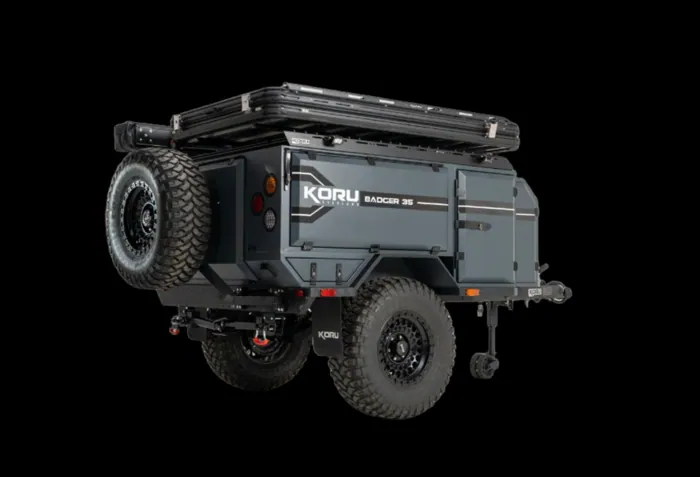
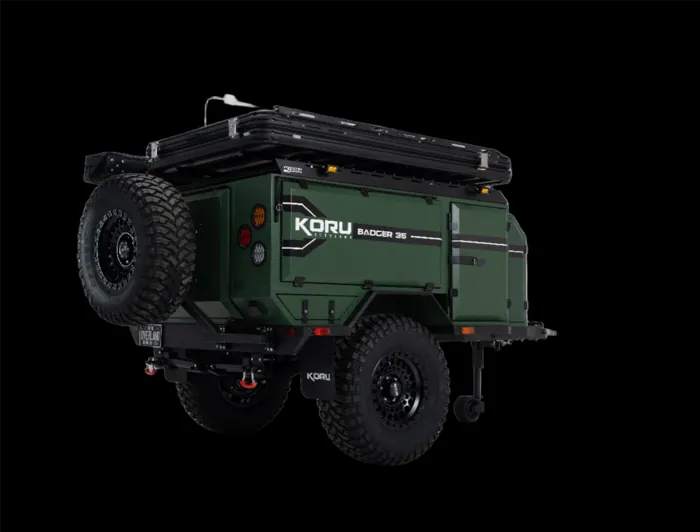
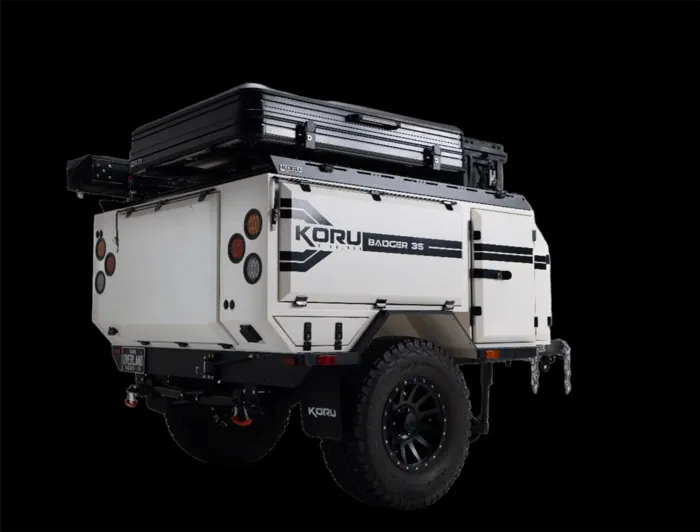
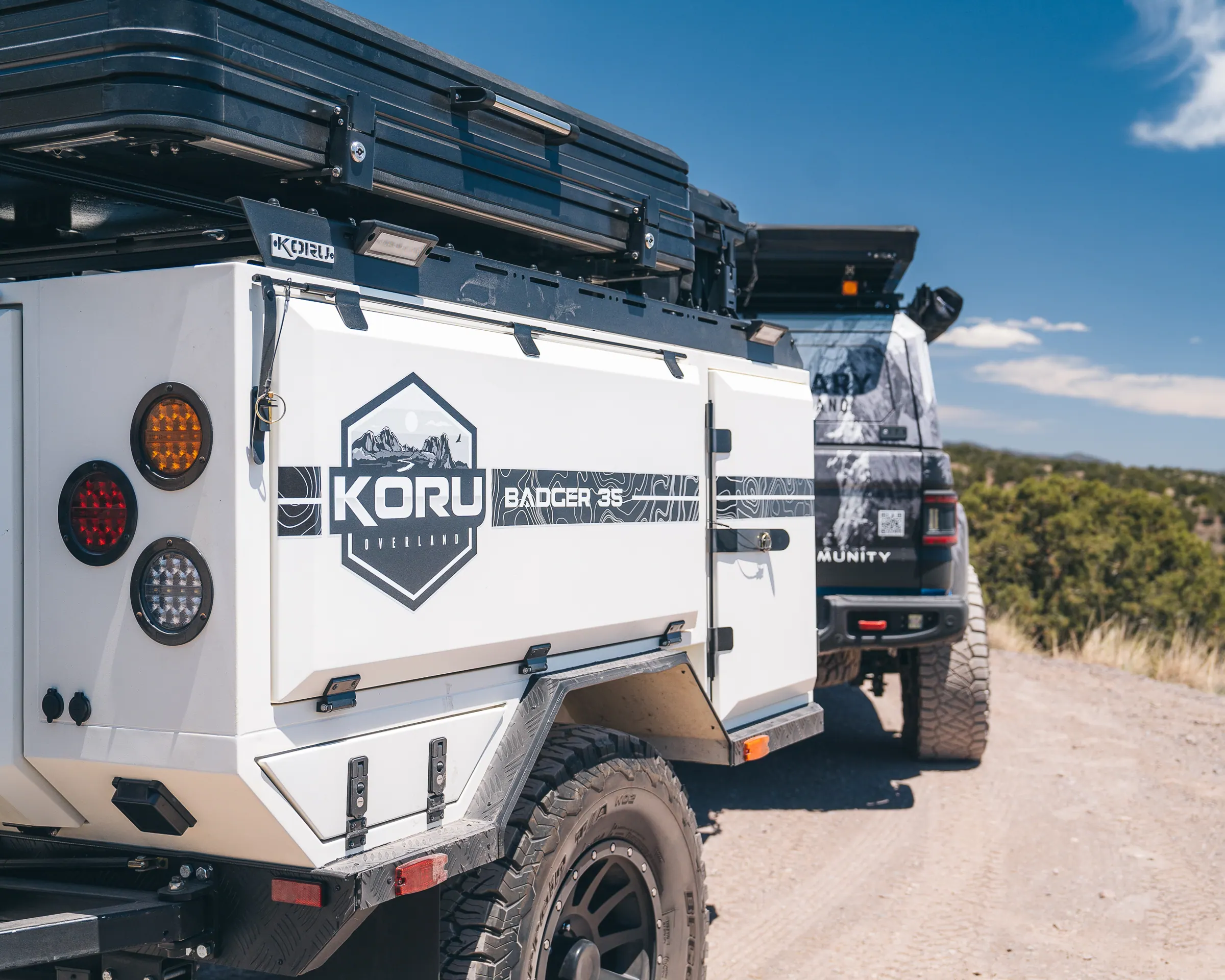
Our four in-stock Badger 35 trailers are at the Addison showroom, and you are welcome to work through this list on any of them. Browse the in-stock collection or contact us to set a time.
Common questions
How do I tell how old a trailer's tires are?
Find the DOT code on the sidewall and read the last four digits. The first two are the week and the last two are the year, so 3122 means the 31st week of 2022.
Where is the VIN and certification label on a trailer?
Federal rules put the certification label on the forward half of the left side of a trailer, readable from outside. It lists the manufacturer, month and year of manufacture, GVWR, GAWR and the VIN.
Does a trailer in Texas need a title?
According to the Texas DMV, a manufactured trailer with a gross weight over 4,000 lb must be titled, and a new trailer is documented with a Manufacturer's Certificate of Origin. Confirm current rules with your county tax office.
How do I check a trailer's propane system for leaks?
Open the cylinder valve and brush or spray soapy water on every fitting from the cylinder to the appliances. Growing bubbles mean a leak. Never use a match or lighter to test.
How do I test a trailer's lithium battery before buying?
Read state of charge, voltage and any fault history on the battery monitor or BMS app, then run a known load through the inverter and watch how the voltage and charge level respond.
Do trailer wheel bearings need service?
Yes. Dexter, a major axle maker, recommends lubricating trailer bearings every 12 months or 12,000 miles. Ask for service records and check for play and heat after a test tow.
Written by the Koru Overland team, a service-disabled veteran-owned company in Addison, Texas. Questions? Call (214) 912-6102 or contact us.