What Is an Overland Trailer? Off-Road Campers Explained
An overland trailer is a compact, off-road camper built to follow a 4x4 onto dirt roads and camp without hookups. Learn the parts, types and 2026 prices.
· Koru Overland
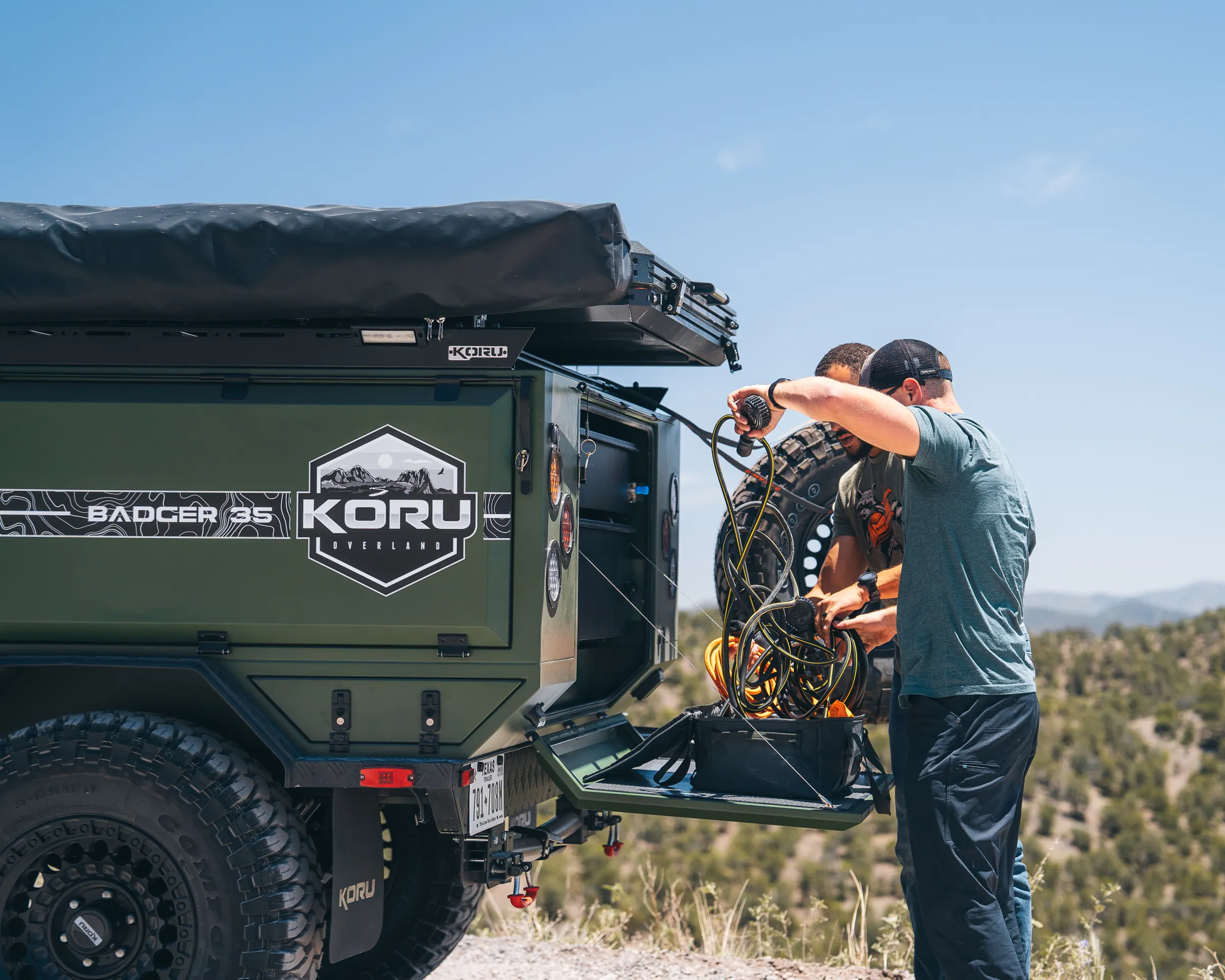
An overland trailer is a compact camper trailer built to follow a four-wheel-drive vehicle down rough dirt roads and support camping for several days without hookups. Compared with a standard travel trailer, it gives up interior space in exchange for ground clearance, all-terrain tires, a tougher suspension, and its own power, water and kitchen. Think of it as a basecamp you can tow where an RV cannot go.
We sell one model of overland trailer from our showroom in Addison, Texas, but this guide is written to explain the category, not a single product. If you are already shopping, our overland trailer buying guide goes deeper on weights, power and a checklist.
What does “overland” mean?
Overlanding is self-reliant travel over long distances, mostly on unpaved roads, where the journey and remote camping are the point rather than a single destination. An overland trailer is the equipment that makes that kind of trip comfortable for more than a night or two.
There is no legal or industry definition of an overland trailer. In practice, the term describes trailers that share most of these traits:
- Ground clearance high enough to clear ruts, rocks and washouts.
- All-terrain or light-truck tires, often in the same size as the tow vehicle.
- A suspension designed for repeated impacts and articulation, not only highway miles.
- Off-grid systems: a battery bank, a fresh water tank, a camp kitchen and usually refrigeration.
- A compact footprint, typically about 10 to 16 feet long, so it fits narrow trails and tight turnarounds.
How is an overland trailer different from a travel trailer?
A conventional travel trailer is designed for paved roads and developed campgrounds. It maximizes interior living space, usually relies on campground hookups for water and electricity, and sits low to the ground.
An overland trailer reverses those priorities. Here is how the two typically compare:
| Feature | Typical travel trailer | Typical overland trailer |
|---|---|---|
| Intended roads | Pavement, graded gravel | Dirt roads, two-tracks, rough trails |
| Length | Often 18 to 30+ ft | Often 10 to 16 ft |
| Ground clearance | Low | High, often 14 to 25 in. |
| Tires | Highway trailer tires | All-terrain or light-truck tires |
| Living space | Full interior, standing room | Rooftop tent or small cabin; outdoor kitchen |
| Off-grid ability | Limited without hookups | Built around battery, water and propane |
| Towing | Often needs a full-size truck | Many fit midsize or half-ton trucks |
Neither is better. A travel trailer is more comfortable at a campground. An overland trailer is more capable once the pavement ends.
What are teardrop and squaredrop trailers?
A teardrop trailer is a small camper whose profile curves down at the back, like a teardrop on its side. Inside is usually a bed-sized cabin, and the kitchen sits under a rear hatch. A squaredrop uses the same idea in a boxier shape, which tends to add headroom and storage.
Teardrops and squaredrops are not automatically overland trailers. Many are highway models. Off-road versions add clearance, bigger tires and a heavier suspension. Hiker Trailer, for example, sells Highway Lite and Highway Deluxe models alongside an Extreme Off Road model with 285/70R17 tires, 14 inches of ground clearance and a 2,900 lb GVWR.
What are the main parts of an overland trailer?
Suspension
Off-road trailers use several suspension types: leaf springs, coil springs, torsion or rubber-cushioned axle-less units, airbags, and fully independent designs. Each trades off articulation, ride quality, maintenance and cost. What matters most is wheel travel, shock quality, and whether you can service it far from home.
Clearance and departure angle
Ground clearance is the distance from the ground to the lowest point under the trailer. Departure angle is the steepest slope the trailer’s rear can leave without dragging. Off Grid Trailers lists a 50 degree departure angle and 21 inches of clearance for its Switchback, which gives a sense of the targets in this category.
Tires and wheels
Matching your vehicle’s tire size and bolt pattern means one spare covers both. Common overland trailer tire sizes run from about 31 to 35 inches tall on 16 or 17 inch wheels.
Power
The power system is a battery bank (AGM or lithium), charging inputs (shore power, vehicle DC-DC charging and solar), and often an inverter for 120V devices. Battery capacity is best compared in kilowatt-hours: a 150Ah, 12V lithium battery stores about 1.9 kWh. Our off-grid power guide explains the math in more detail.
Water
Most overland trailers carry 14 to 31 gallons of fresh water, often with a pump, a sink and an on-demand water heater. Water weighs about 8.3 lb per gallon, so a full tank adds real weight. Onboard filters generally improve taste, odor and clarity; unless a filter is certified for it, treat or disinfect water per local health guidance.
Sleeping: tent or cabin
This is the biggest design choice:
- Rooftop tent (RTT): a tent mounted on the trailer’s rack that folds open in minutes. Lighter and cheaper, but you are sleeping in fabric.
- Teardrop or squaredrop cabin: a hard-walled sleeping box with a mattress. Better in wind, rain and cold.
- Pop-top or full cabin: more interior room, sometimes a bathroom, at the cost of size and weight.
We compare these in detail in overland trailer vs rooftop tent vs teardrop.
How much does an overland trailer cost?
Prices vary widely with the power system, suspension and included gear. Here are current starting prices from manufacturers’ own websites, checked in October 2026:
| Example | Type | Starting price | Source |
|---|---|---|---|
| Hiker Trailer Extreme Off Road (5x9) | Off-road squaredrop | $15,299 | Hiker Trailer |
| Off Grid Trailers Switchback | Rooftop-tent-ready platform | $22,999 | Off Grid Trailers |
| SNO Trailers Alpine | Rooftop-tent-ready platform | $29,995 | SNO Trailers |
| Escapod TOPO2 Nomad | Off-road teardrop | $33,990 | Escapod |
| Off Grid Trailers Expedition 3.0 | Cabin trailer | $34,999 | Off Grid Trailers |
| Black Series HQ12 | Pop-top hybrid camper | $49,899 | Black Series |
Two cautions. First, starting prices often exclude items you may consider essential, such as a rooftop tent, fridge, awning or lithium battery. Hiker, for instance, lists an average as-built price of about $24,000 for the 5x9 Extreme Off Road. Second, weights and sizes vary just as much: the Black Series HQ12 has a 7,500 lb GVWR, more than double most of the others.
A rough rule for 2026: basic off-road teardrops start under $20,000, well-equipped rooftop-tent and cabin trailers fall between about $23,000 and $45,000, and larger pop-top or fully loaded models approach or pass $50,000. See our comparison of the best overland trailers under $50,000 for specs side by side.
Who is an overland trailer for?
An overland trailer makes the most sense if you:
- Camp off pavement on forest roads, desert two-tracks or ranch land, where a travel trailer would struggle.
- Want a permanent camp setup: a kitchen, fridge and power that stay packed and ready.
- Take trips of several days without hookups.
- Want to free up your vehicle, moving gear, water and weight off the truck bed and roof.
- Are comfortable with a tent or small cabin instead of an RV interior.
It is probably not the right fit if you mostly stay at full-hookup campgrounds, need a bathroom and standing room every night, or travel with a family of four or more who all want indoor beds.
What should I check before buying?
Start with weight. Compare the trailer’s GVWR (its maximum loaded weight) with your vehicle’s tow rating, and estimate tongue weight against your vehicle’s payload. Our guide on whether a half-ton truck can tow an overland trailer works through that math. Then look at tires, suspension serviceability, battery capacity in kWh, water capacity and the sleeping setup.
Overland trailers at Koru in Addison, Texas
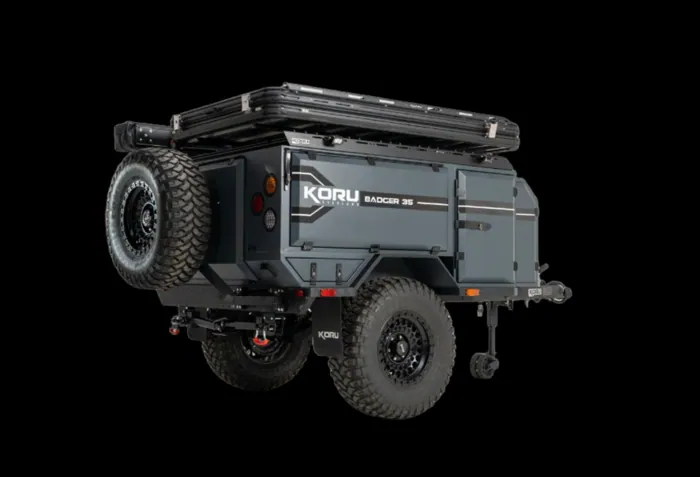
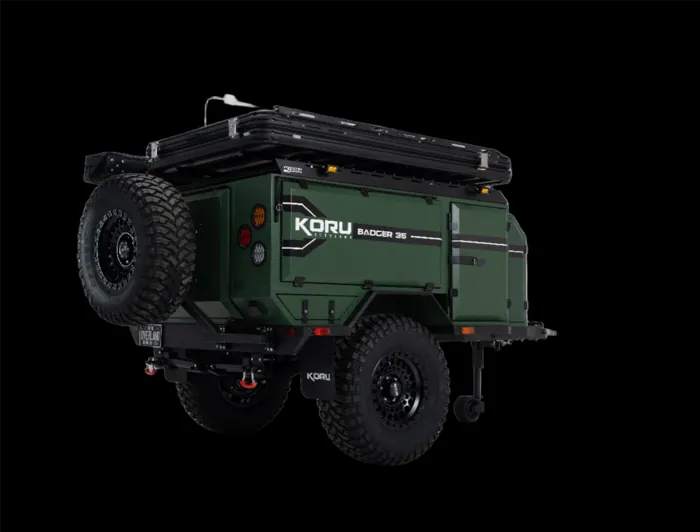
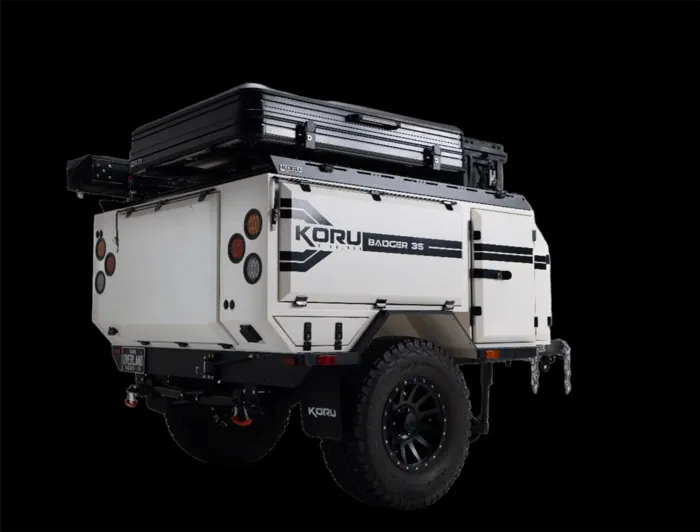
Koru Overland has four 2023 Badger 35 overland trailers in stock at our showroom in Addison, north of Dallas. The Badger 35 is a rooftop-tent design with a 3,307 lb GVWR, 35x12.5 R17 all-terrain tires, a REDARC 150Ah self-heating lithium system with a 3,000 W inverter, Dometic fridge/freezers and a 21 gallon water tank. It sleeps one to two adults, and the in-stock price is $44,900.
You can compare all four colors on our inventory page or contact us to see one in person.
Common questions
What is the difference between an overland trailer and a travel trailer?
A travel trailer is built for paved roads and campgrounds, with a large interior and low ground clearance. An overland trailer is smaller and built for dirt roads, with more clearance, all-terrain tires, a tougher suspension and self-contained power and water.
Is a teardrop trailer an overland trailer?
Only if it is built for off-road use. Many teardrops are designed for highways and campgrounds, while off-road teardrops add clearance, larger all-terrain tires and a heavier suspension.
What is a squaredrop trailer?
A squaredrop is a small camper with a boxy, squared-off profile instead of the curved teardrop shape. The box shape usually gives more headroom and storage for the same length.
How much does an overland trailer cost?
New off-road teardrops start below $20,000 before options, while equipped overland trailers with kitchens, cabins or rooftop tents commonly cost $23,000 to $50,000. Prices depend heavily on the power system, suspension and included equipment.
Do I need a big truck to tow an overland trailer?
Not always. Many overland trailers have a gross vehicle weight rating between about 2,900 and 3,500 lb, which is within the rated capacity of many midsize and full-size trucks, but you must check your own vehicle's tow rating, payload and hitch rating.
Written by the Koru Overland team, a service-disabled veteran-owned company in Addison, Texas. Questions? Call (214) 912-6102 or contact us.